
Dr. Nitish Mandal
Costochondritis Treatment in Bangalore
Costochondritis is chest-wall pain at the rib-breastbone junctions. It can feel like heart pain even when the ECG is normal. Dr. Nitish Mandal assesses persistent cases at Koramangala and J.P. Nagar after cardiac causes have been checked.

Costochondritis is inflammation or irritation involving the junction between the ribs and the breastbone (sternum). It can cause significant chest pain that may feel frighteningly similar to heart pain.
For some patients, the pain settles within a few weeks. But chronic or recurrent costochondritis can persist for months or years, interfere with sleep and exercise, and become difficult to treat when multiple painful points are involved.
What is costochondritis?
Costochondritis is a painful condition affecting the junctions between the ribs and the sternum, usually causing localized chest-wall pain and tenderness.
The pain commonly occurs near the front of the chest where the ribs attach to the breastbone.
It may be
- Sharp or stabbing
- Aching or burning
- Tender to touch
- Worse with certain movements
- Worse with deep breathing or coughing
- Worse when stretching or using the upper body
- Present on one or several areas of the chest
Although costochondritis is generally not a heart condition, new or unexplained chest pain should never automatically be assumed to be costochondritis.
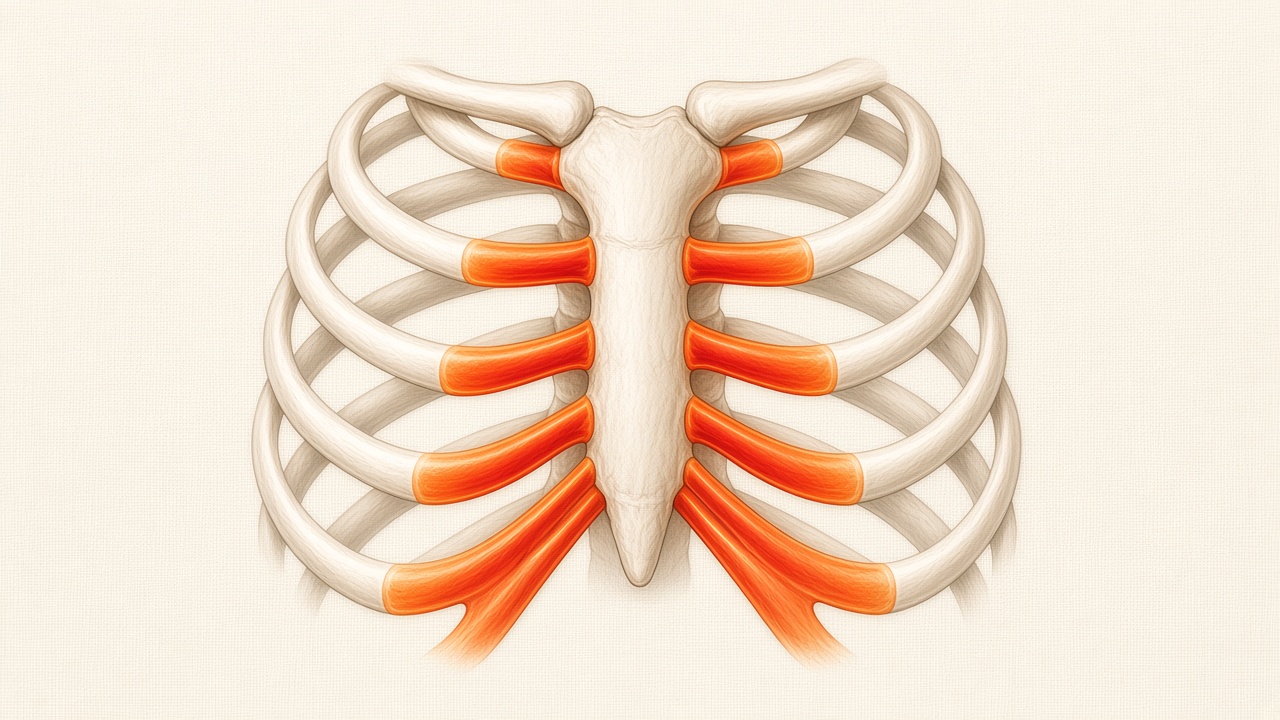
Where does costochondritis pain occur?
Costochondritis most commonly causes pain around the front of the chest near the rib-sternum or rib-cartilage junctions.
Patients may describe the pain as being:
- Beside the breastbone
- Under or around the breast
- Along one or more ribs
- In the upper chest
- On one side or both sides of the chest
The exact location matters because different chest-wall structures can produce similar symptoms.
What does costochondritis pain feel like?
Costochondritis pain can feel sharp, stabbing, aching, burning, or pressure-like.
Some patients experience pain only at a particular spot, while others describe pain spreading across the chest.
The pain may increase with:
- Deep breathing
- Coughing or sneezing
- Turning or twisting
- Lifting weights
- Push-ups or other upper-body exercises
- Stretching
- Certain sleeping positions
- Pressing on the painful area
Because chest pain has many possible causes, the character of the pain alone cannot establish the diagnosis.
Why can chest pain continue when tests are normal?
Can it feel like heart pain?
Yes. Costochondritis can produce chest pain that is frighteningly similar to cardiac pain.
This is one reason patients with chest pain often undergo ECGs, echocardiography, stress testing, or other cardiac investigations.
However, normal cardiac investigations do not automatically prove that the pain is costochondritis. They simply make certain cardiac causes less likely, depending on the patient's clinical situation and the tests performed.
The next step is to determine whether the pain is coming from the chest wall or another source.
Can the ECG be normal?
Yes. An ECG can be completely normal in a patient whose chest pain is coming from the chest wall.
Can an MRI be normal?
Yes. A normal MRI does not mean that a patient's chest pain is imaginary or that there is no treatable pain generator.
Many pain conditions are diagnosed primarily through clinical examination, pain reproduction, and correlation with anatomy, rather than through a visible abnormality on a scan.
Because not all chest pain originates from the heart. Chest pain can arise from several systems, including:
- Heart and blood vessels
- Lungs and pleura
- Gastrointestinal tract
- Muscles
- Ribs and costochondral structures
- Intercostal nerves
- Other nerves of the chest wall
- Referred pain from the spine or surrounding tissues
Therefore, when cardiac and other serious causes have been appropriately evaluated, a detailed examination of the chest wall and musculoskeletal system becomes important.
How is costochondritis diagnosed?
Costochondritis is primarily a clinical diagnosis based on the patient's history and physical examination.
There is no single blood test, MRI, or scan that definitively proves costochondritis in every patient.
During an assessment, the doctor may look for:
- The exact location of symptoms
- Whether the pain can be reproduced by palpation
- Whether particular movements reproduce the symptoms
- Which ribs or chest-wall structures are involved
- Whether there are multiple painful points
- Whether nerve or referred pain may be contributing
- Whether another condition better explains the symptoms
Investigations may be required depending on the patient's age, symptoms, risk factors, and clinical findings.
Why does costochondritis become chronic?
Most uncomplicated cases improve with time. However, some patients develop persistent or recurrent chest-wall pain. Possible contributing factors include:
- Repeated mechanical stress
- Poor biomechanics
- Repetitive upper-body activity
- Previous injury
- Persistent inflammation or irritation
- Multiple painful chest-wall structures
- Myofascial pain
- Nerve-related pain
- Sensitisation of the pain system
In chronic cases, it is particularly important not to keep treating the diagnosis rather than the actual pain generator.
Why does it keep coming back?
Recurrent pain does not necessarily mean that the same painful point has returned.
In some patients with chronic multi-point chest-wall pain, one particularly painful area may improve substantially while another previously less noticeable area becomes symptomatic.
This can give the impression that the original costochondritis has come back.
A careful examination can help determine whether the recurrent pain is actually arising from the same structure or from a different untreated pain generator.
Can it affect more than one rib?
Yes. Some patients have pain involving several rib or chest-wall junctions.
When there are multiple painful points, treating only the most painful area may provide incomplete relief.
This is why mapping the painful areas during clinical examination can be useful in chronic cases.
Can it last for years?
Yes. Although many cases improve relatively quickly, some patients experience persistent or recurrent chest-wall pain for months or years.
When pain persists for a long time, it is worth reassessing the diagnosis and looking for:
- Multiple pain generators
- Myofascial pain
- Nerve involvement
- Referred pain
- Persistent inflammatory pain
- Other musculoskeletal causes of chest pain
Long duration does not necessarily mean that the pain cannot improve.
Is chronic costochondritis treatable?
Many patients with chronic chest-wall pain can improve substantially when the actual pain generator is identified and treated appropriately.
The goal should not simply be to keep giving painkillers whenever symptoms flare.
Instead, the evaluation should attempt to answer:
- Where exactly is the pain coming from?
- Why has it persisted?
- Is there one pain generator or several?
- Is the pain inflammatory, myofascial, neuropathic, or referred?
The answers determine the treatment strategy.
What is the treatment for costochondritis?
Treatment depends on what is actually generating the pain.
Uncomplicated acute care
For uncomplicated acute costochondritis, treatment may include:
- Relative rest
- Activity modification
- Analgesic or anti-inflammatory medication when appropriate
- Local measures
- Physiotherapy or appropriately selected exercises
Persistent pain
Chronic cases can require a different approach.
If a specific chest-wall structure is responsible for persistent pain, targeted treatment of that structure may be considered.
Do steroid injections help?
In selected patients with persistent, localized inflammatory chest-wall pain, a corticosteroid injection can provide significant relief.
Steroid injections are not necessary for every case and should not be used indiscriminately.
The important question is whether there is a specific structure that can be identified clinically as the source of pain and appropriately targeted.
When an injection is considered, accurate localization is important.
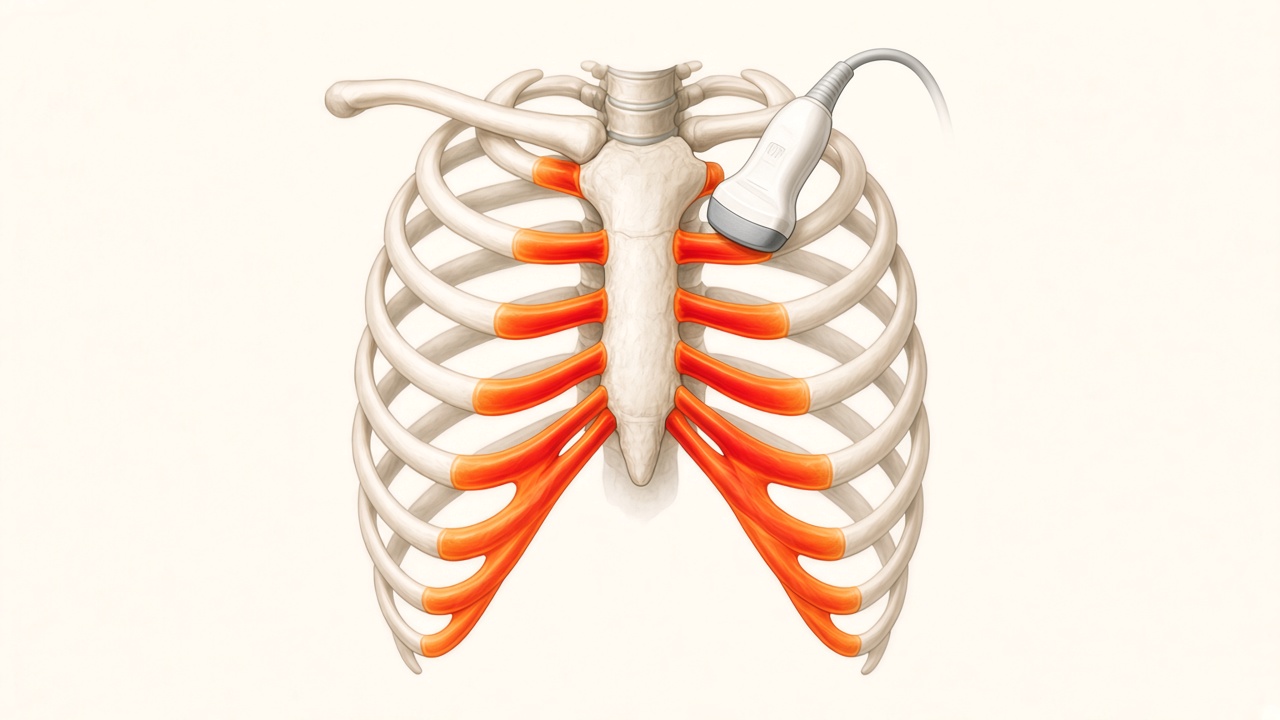
Are ultrasound-guided injections useful?
Ultrasound guidance can help the physician identify the relevant anatomy and place an injection accurately when an injection is clinically appropriate.
Ultrasound may allow the doctor to visualise:
- Ribs
- Costal cartilage
- Surrounding soft tissues
- Muscles
- Relevant anatomical structures
The purpose is not simply to give an injection, but to target the suspected pain-generating structure as accurately as possible.
Does dry needling cure it?
Dry needling may be useful for some muscular or myofascial pain problems, but it should not be assumed to permanently treat every type of chest-wall pain.
A tight or painful muscle may behave differently from an inflammatory or degenerative enthesis or costochondral pain generator.
Therefore, treatment should be selected according to the suspected source of pain, rather than applying the same procedure to every patient.
Can saline or lignocaine injections help?
They may have a role in selected myofascial trigger-point pain, depending on the clinical diagnosis.
However, the treatment of an actual inflammatory enthesis or costochondral pain generator may be different.
This is why differentiating myofascial pain from costochondral or enthesis-related pain is clinically important.
When should I see a pain specialist?
Consider consultation with a pain specialist when:
A pain specialist can assess whether the pain is actually coming from the costochondral region or from another structure.
What happens during a consultation?
The most important part is a detailed clinical assessment.
I would typically want to understand:
- Where the pain began
- How long it has been present
- What makes it worse
- What makes it better
- Whether there is tenderness
- Whether movement reproduces the pain
- Which ribs or areas are involved
- Whether there are multiple painful points
- What investigations have already been performed
- What treatments have already been tried
- How the pain has responded to previous treatments
If appropriate, the examination can then guide a targeted treatment strategy.
More questions about chest-wall pain
Can diagnostic blocks help identify the source of chest-wall pain?
Yes. In selected patients, a diagnostic injection or block can be used as part of the process of identifying whether a particular structure is contributing to the pain.
The principle is straightforward. If a carefully targeted intervention produces a substantial, anatomically consistent change in the patient's characteristic pain, that information can help support the clinical diagnosis.
A diagnostic block should therefore be viewed as part of a diagnostic and therapeutic strategy, not simply as an injection for temporary pain relief.
Why is identifying the exact pain generator important?
Because chest pain is a symptom, not a diagnosis.
Two patients may both say they have pain near the ribs. One may have costochondral pain, another may have myofascial pain, and another may have a nerve-related or referred pain syndrome.
If the underlying source is different, the treatment should be different. This is particularly important when previous treatment has repeatedly failed.
Can chronic costochondritis be treated without surgery?
Yes. Costochondritis is generally managed without surgery.
Treatment may involve medication, activity modification, physiotherapy, targeted injections, and other pain-management strategies depending on the diagnosis.
Surgery is not the routine treatment for uncomplicated costochondritis.
Why isn't my chest pain improving despite taking medicines?
There are several possible explanations.
The original diagnosis may be incomplete, there may be more than one pain generator, or the pain may be coming from a different structure altogether.
In chronic pain, repeatedly increasing medication without reassessing the diagnosis may not solve the underlying problem.
When treatment is failing, the diagnosis deserves to be reconsidered.
Can costochondritis cause pain on the left side of the chest?
Yes. Costochondritis can occur on either side of the chest, including the left side.
However, left-sided chest pain should never automatically be diagnosed as costochondritis, particularly when it is new or unexplained. Cardiac causes should be appropriately considered based on the clinical situation.
Can costochondritis cause pain while breathing?
Yes. Chest-wall pain can become worse with deep inspiration because movement of the ribs and surrounding tissues can aggravate the painful area.
However, pain associated with breathing can also occur with pulmonary and other conditions, so the symptom should be interpreted in context.
Can costochondritis cause back or shoulder pain?
It can sometimes coexist with or contribute to pain around the upper back, shoulder, or chest because the muscles, joints, ribs, and nerves of these regions function together.
However, pain extending beyond the chest should prompt a broader assessment rather than assuming that everything is caused by costochondritis.
What is the difference between costochondritis and Tietze syndrome?
Both conditions involve pain around the costochondral region, but they are not identical.
Costochondritis generally causes pain and tenderness without prominent swelling, whereas Tietze syndrome is classically associated with localized swelling of a costochondral joint.
A clinical examination is needed to distinguish them and to exclude other causes of chest-wall pain.
Can exercise cause costochondritis?
Repetitive or strenuous upper-body activity can contribute to chest-wall pain.
Activities such as heavy weight training, push-ups, or repetitive movements may aggravate susceptible chest-wall structures.
However, exercise does not necessarily mean that the patient has costochondritis. The specific pain generator should be identified.
What should I do if my costochondritis keeps coming back?
If the pain repeatedly returns, do not simply assume that you need another course of the same treatment.
Instead, reassess:
- Is it the same painful point?
- Are new areas involved?
- Is there a muscular component?
- Is there nerve involvement?
- Is there referred pain?
- Is the diagnosis still correct?
- Is there an underlying mechanical factor perpetuating the pain?
This approach is particularly relevant in chronic multi-point chest-wall pain.
Costochondritis treatment in Bangalore
If you have persistent chest-wall pain despite normal cardiac investigations or previous treatment, a detailed pain assessment can help determine whether the pain is truly coming from the costochondral region and what treatment may be appropriate.
I am Dr. Nitish Mandal, MD, FIPM, TIPM (Nashville), a pain specialist with extensive experience in interventional pain management.
J.P. Nagar Pain Clinic
Above the MG showroom and below Cult Gym, J.P. Nagar, Bengaluru.
Koramangala Pain Clinic
1st floor of Sulochana Building, 365, 1st Cross Rd, 3rd Block, Santhosapuram, Koramangala, Bengaluru, Karnataka 560034.
Appointments and WhatsApp: +91 80502 87888.
Website: PainDoctorBangalore.com.
Frequently asked questions about costochondritis
- Is costochondritis dangerous?
- Costochondritis itself is generally not considered a dangerous condition, but chest pain should not automatically be attributed to it without appropriate assessment.
- Does costochondritis go away?
- Many cases improve, but some patients develop persistent or recurrent chest-wall pain requiring further evaluation.
- How long does costochondritis last?
- The duration varies considerably. Acute cases may settle relatively quickly, while chronic cases can persist much longer.
- Can costochondritis be cured?
- Many patients improve substantially, but treatment depends on the underlying pain generator and whether there are additional sources of pain.
- Can costochondritis come back?
- Yes. Recurrent symptoms are possible, although they may come from a different chest-wall structure rather than the same original point.
- Can costochondritis feel like heart pain?
- Yes. Costochondritis can produce chest pain that feels frighteningly similar to cardiac pain. Normal cardiac tests make some heart causes less likely; they do not by themselves prove costochondritis.
- Can the ECG be normal with costochondritis?
- Yes. An ECG can be completely normal when chest pain is coming from the chest wall. A normal ECG is not a diagnosis of costochondritis.
- What is the difference between costochondritis and Tietze syndrome?
- Both involve pain around the costochondral region. Costochondritis generally causes pain and tenderness without prominent swelling. Tietze syndrome is classically associated with localized swelling of a costochondral joint. Clinical examination distinguishes them.
- Can diagnostic blocks help identify chest-wall pain?
- Yes. In selected patients, a carefully targeted diagnostic injection or block can show whether a particular structure is contributing to the pain, as part of diagnosis and treatment planning.
- Can chronic costochondritis be treated without surgery?
- Yes. Costochondritis is generally managed without surgery, using medication, activity modification, physiotherapy, targeted injections, and other pain-management strategies. Surgery is not the routine treatment for uncomplicated costochondritis.
- Can costochondritis cause pain on the left side of the chest?
- Yes. It can occur on either side, including the left. Left-sided chest pain should never automatically be diagnosed as costochondritis when it is new or unexplained. Cardiac causes should be considered based on the clinical situation.
- Can costochondritis cause pain while breathing?
- Yes. Chest-wall pain can worsen with deep inspiration because rib movement can aggravate the painful area. Pain with breathing can also occur with pulmonary and other conditions, so the symptom is interpreted in context.
New, severe, unexplained, or concerning chest pain should be medically evaluated rather than automatically attributed to costochondritis. Reviewed by Dr. Nitish Mandal, MBBS, MD, FIPM, TIPM (Nashville). Clinics: Koramangala and J.P. Nagar.
Page chat
Ask about costochondritis
The questions on this page, with answers taken from the same details shown above.
Chat
Pain clinic
Typically replies on WhatsApp
My ECG is normal but my chest still hurts.
That can be costochondritis: inflammation or irritation at the rib-breastbone junction. A normal ECG does not prove the diagnosis. The chest wall still needs to be examined.
How is it treated if pills fail?
Treatment depends on the pain generator. In selected cases that can include activity change, physiotherapy, or a targeted ultrasound-guided injection. Not every case needs an injection.